Cattle Feedlots


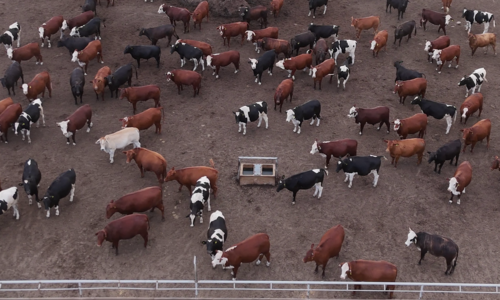
During our research on horse meat production and blood farms in South America, we came across what are known as cattle feedlots. These are huge open-air fattening farms where cattle are kept in confined space without access to pasture.
Meat from feedlots is exported as “High Quality Beef” (HQB) to the EU and Swiss market. The EU and Swiss import regulations for HQB require that bovines have been fed a diet containing 62 - 70 % of grain for at least 100 days before slaughter. This feed gives the meat a characteristic colour and texture. However, such feeding requirements are against the welfare and health of ruminants, whose digestion is meant for roughage. As the proportion of grain increases in the diet, the risk of metabolic diseases increases as well.
In 2025 and 2026, our teams documented 21 EU-approved feedlots in Uruguay, Argentina and Brazil. The investigations identified systematic animal welfare problems:
The bovines have permanent access to grain feed, and many are severely overweight. In the 100 - 200 days of confinement, they achieve a weight gain of up to 1.5 kg per day.
Most animals have no protection from adverse weather conditions, which leads to extreme heat stress in summer. Only a few feedlots offer shelter, but insufficient in number and size.
Drinking water quality is usually poor; many troughs show biofilm buildup or algae contamination, which can release toxins into the water.
Usually only one drinking trough per large group (> 100 animals) is provided, causing crowding and competition and limiting access to water for subordinate animals.
The feedlot floors are a mixture of excrement and soil. The animals have difficulties walking in the deep manure. After rainfall, they sink into the mud up to their knees.
The bovines have to lie down in the dirt, as there are no dry and clean resting areas. A large number of animals are excessively soiled with faeces.
Given the sheer number of animals, sick, emaciated, lame and injured bovines go undetected and untreated.

Free Trade Agreements
The EU and the EFTA (Switzerland, Iceland, Liechtenstein, Norway) have each negotiated a free trade agreement with the Mercosur states, but neither agreement contains binding, enforceable animal welfare standards. The EU-Mercosur agreement significantly reduces tariffs on a quota of 99,000 tonnes of beef. Under the EFTA-Mercosur agreement, Switzerland will grant a bilateral tariff quota of 3,000 tonnes of beef in addition to the existing WTO import quota. Both the existing quota and the additional quota will be duty-free.
The EU-Mercosur agreement is currently being applied provisionally, although it has not yet been ratified by the European Parliament. The EFTA-Mercosur agreement has not yet been ratified either. The Swiss Parliament will discuss the agreement during its 2026 summer and autumn sessions.

Our Claims
The European and Swiss Parliaments must include binding and enforceable animal welfare standards in the Mercosur free trade agreements. We recommend withholding the ratification and renegotiating new agreements which condition market access of animal products on compliance with relevant European animal welfare standards.
Regardless of the Mercosur agreements, the EU and Switzerland must ban the import of cruelly produced feedlot beef and ensure that all beef from third countries comes from pastures.
The EU is currently in the process of adopting a new animal welfare legislation and must ensure it also applies to imported products.
Videos:
- Documentary Film "The Myth of Green Pastures", 2026 (Investigation of Animal Suffering in Feedlots within the Scope of EU-Mercosur Trade)
- Trailer
Open Letter to the Minister of Economic Affairs: Stop the Import of Feedlot Meat

Swiss broadcaster SRF reports on our investigation into cattle feedlots in South America

New Film about Cattle Feedlots in South America
![[Translate to AWF: English:]](/files/_processed_/9/9/csm_Screenshot_2026-06-11_094637_a44d5f9e9f.jpg "[Translate to AWF: English:]")
Press Release “Spiridon II” Hearing: Organizer of the Horrific Transport to Appear in Austrian Court on Friday

‘The problem is not the antibiotics’: Animal welfare groups react angrily to Brazilian meat ban - Euronews reports

Thousands of Cattle Trapped at Sea – Livestock Ship Spiridon II Stuck off the Turkish Coast
Read all investigation reports
Read all investigation reports
Press Release “Spiridon II” Hearing: Organizer of the Horrific Transport to Appear in Austrian Court on Friday
‘The problem is not the antibiotics’: Animal welfare groups react angrily to Brazilian meat ban - Euronews reports
Thousands of Cattle Trapped at Sea – Livestock Ship Spiridon II Stuck off the Turkish Coast