Heat Protection Put to the Test—Investigation Reveals Significant Shortcomings at German Slaughterhouses

Project Manager Iris Baumgärtner documents a truck waiting outside a German slaughterhouse.
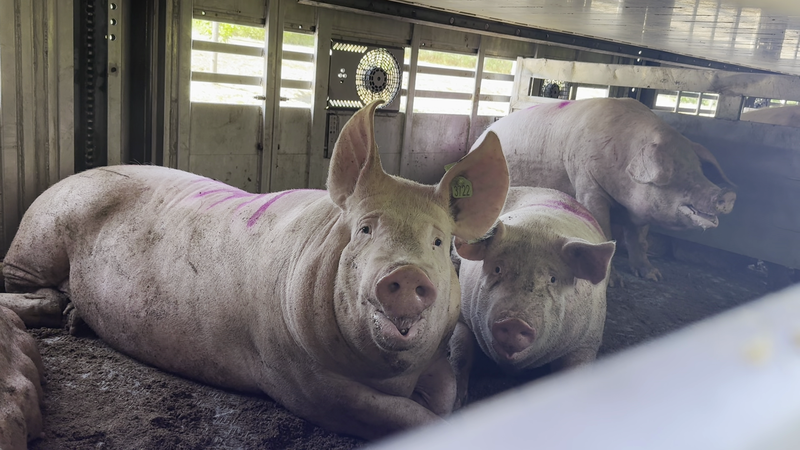
The sows in this truck were suffering from severe heat stress, as evidenced by their panting and increased breathing rate.
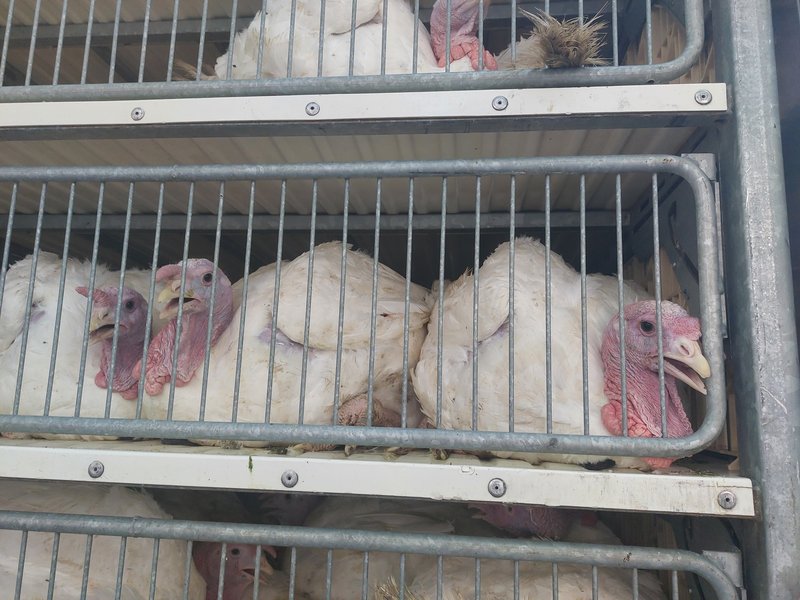
Although these turkeys were parked under trees in a nearby parking lot due to a lack of shade at the slaughterhouse, they still showed clear signs of heat stress.
How well do German slaughterhouses protect animals from extreme heat? Our investigation shows that many slaughterhouses lack effective measures or that the measures in place are insufficient. This can be life-threatening for the animals. We call for effective heat protection and species-specific temperature limits to ensure that animals are not transported when temperatures are too high.
Hot summer days can pose a life-threatening strain on animals on their way to the slaughterhouse. Especially during the waiting period in the transport vehicle, high temperatures, a lack of shade, and poor air circulation can lead to significant heat stress.
We wanted to know what measures German slaughterhouses are taking to protect animals in high temperatures. So we contacted several companies in different federal states. The response was sobering: only one facility replied.
So we investigated on our own. From June through August, we documented conditions at 18 slaughterhouses, including poultry, swine, and cattle slaughterhouses.
Six Slaughterhouses with Inadequate Heat Protection
First, the good news: About half of the slaughterhouses inspected have implemented heat protection measures. These include portable air coolers, fans, and shaded waiting areas. Many facilities also schedule deliveries for cooler times of the day and reduce the number of animals transported.
At some facilities, we were unable to conclusively assess how they protect animals from heat due to their size.
Six facilities, however, stood out for the wrong reasons:
- Three slaughterhouses had no heat protection measures at all.
- Three had only inadequate measures in place.
We were able to see the consequences immediately during our observations.
Sows Forced to Wait in the Transport Truck in the Heat
At one of the slaughterhouses investigated, a transport truck carrying sows did not arrive on the premises until early afternoon, when the sun was already high in the sky. The animals’ respiratory rates were significantly elevated, and many were panting heavily. Desperately, they stuck their snouts through the bars, apparently in search of fresh air.
Despite their condition, the pigs were initially forced to wait in the transport vehicle. It was only when we began filming and announced that we would call the police that the vehicle was allowed onto the slaughterhouse grounds and the animals were finally unloaded.
At another slaughterhouse, trucks carrying panting turkeys were parked in a public parking lot. There was no shade on the slaughterhouse grounds.
We have called on the slaughterhouse operators and the relevant veterinary authorities to take effective measures immediately to protect the animals.
Heat quickly becomes a stressor for animals
The extent to which animals suffer from heat depends, among other things, on the species, age, and humidity. For breeding sows, critical stress levels can be reached already at about 22 °C. According to the European Food Safety Authority (EFSA), the threshold for cattle, pigs, and poultry is around 25 °C, and for unshorn sheep, it is 28 °C. The higher the humidity, the more the animals suffer from the heat.
There are also regulations governing transport to the slaughterhouse: The German Animal Transport Legislation stipulates that animals may not be transported to the slaughterhouse for longer than 4.5 hours when outdoor temperatures exceed 30 °C. After that, they must be unloaded immediately.
In reality, however, delays occur time and again. Animals are then forced to wait for long periods in transport vehicles at high temperatures—as our investigation shows.
„When one heat record follows another, slaughterhouses can’t just carry on as usual. The increasing heat is no longer an exceptional situation, but a challenge to which the industry must adapt. And the authorities must verify that the necessary measures are actually being implemented.“ - Iris Baumgärtner, Project Manager
Our investigation continues
Our investigation is not yet complete with the documentation of the 18 slaughterhouses. We want the authorities to tell us what measures the slaughterhouses which we were unable to inspect are implementing.
We are filing complaints against facilities with inadequate or no heat protection. Such complaints are time-consuming and costly. Nevertheless, we’re staying on top of this—because animals must be effectively protected even in high temperatures.
Here’s how you can help animals
If you see a livestock transport vehicle parked in the sun for more than 15 minutes at temperatures above 25 °C and lacking ventilation, please don’t hesitate to alert the police.